by Linda | Sep 23, 2011 | my creative journal
So I’ve been away the past month and a half, vacationing in sunny Southern California with family…but now I’m back in the land of wine and pasta – desperately trying to get back into the groove, frankly. Although I feel rather groggy and overwhelmed even after a week+ of being home, there has been some creative progress in the works… the little lady weekly planners! It’s an artists’ collaboration headed up by anke panke design and I’m really honored to be a part of it.

I have to admit that see a stack of snail mail upon returning from vacation provided a nice deviation from unpacking and the regular ‘ole routine. I’m loving the planner! It’s a perpetual weekly type of planner, so start using it now or save it for the upcoming year – is it too early to refer to 2012?

There’s a whole lot of inspiring art within and there are actually a few cover variations to choose from…but I chose the girlie version and bought myself two copies. My precious little girl illustration is included…yes, I’m smiling from ear to ear and blown away by the quality of the print job.

If you are looking for a creative gift for the holidays or just want a dose of weekly art for yourself…please visit the custom planners Etsy shop. Lots of nice goodies available besides the planners. Thanks to Anke for wrangling it all together!
by Linda | Sep 15, 2011 | my creative journal
Many folks have sworn against using Facebook due to privacy concerns and many think it’s already old fashioned compared to Google+. However, I still think it’s important to establish your business presence on Facebook – get your business page up and running. You can check out some statistics on Facebook and see that it’s still the largest social network today with over 500 million active users daily. People log in multiple times a day and there are countless apps and connections to keep people Facebook-ing all day long.

What you may not realize is that you can sign up for Facebook and literally not use it, only because you want to set up your business page. A business page requires a person to manage it, that is why you must sign up with Facebook personally. But it doesn’t mean you need to start posting personal photos and playing Farmville. In fact, I recommend that you don’t waste time on those things. If you are already on Facebook, be sure to check on these privacy settings for your personal account. Otherwise, you can sign up for an account with your business information… to really separate personal from business. You have to be a real person and as a creative entrepreneur, that means you…but use your business email address and related information.
Setting Up Your Business Facebook Page
Facebook can seem really convoluted at times…and even I have trouble finding certain functions. I suppose there is just so much going on, so I thought to share the general process of creating your business page to help make it easier for creatives and artists alike. To create a page, there is usually a link under the main sign-up page or the easier to find spot for me is in the footer!
Once you click the link you’ll be taken through the process to create your page and they have updated the process to make it as user friendly as possible. Just follow the prompts and fill everything out to get started.

There are a few pointers I have to share though…
Now that you have a page, what do you do? Well, first of all, make sure all your general information and contact is included. It’s crazy how some businesses have a page and then barely any information on it. This is another representation of your business, so put up your profile picture, links to your website and shop and contact information.
- You can automatically get your blog posts onto the Wall through NetworkedBlogs and of course, just post directly newsworthy updates and links as well.
- Use the Events feature, so you can invite people to shows, openings and marketplaces happening around your business.
- Search through the many Facebook Apps available to add your YouTube Videos, Add Your Email Sign-Up, Create a custom Welcome Page, etc …
- Facebook has analytics for your page so check them! http://www.facebook.com/insights/
I hope these tips will help you set up your Facebook Business Page properly. It’s always good to have a presence when there’s such a huge audience out there for you to connect with. Give it a try and next week I’m going to explore a bit about advertising through Facebook. It’s really amazing…
by Linda | Sep 8, 2011 | my creative journal
What is Social Media?
Social media marketing is about getting traffic (publicity) for you and your business through social media networks like Twitter, Facebook, Google+, Linked-In and even your website and blog – wherever there is social interaction between you and others. Ultimately, it’s a pretty wide, catch-all phrase that people use to refer to the various ways we connect online and thus can promote online. It got me to thinking about how connecting with your customers and interacting with them already existed in the past, in traditional businesses, in traditional ways. People used to send updates via snail mail, from formal press releases to catalogs and handwritten notes. People used to call each other up on the phone, go out on lunches, visit the brick and mortar shop and chit chat to build relationships. All that still happens to some degree in real life. However, it’s increasingly more common to have initiated interaction online and in many cases, these relationships remain virtual for life.
 via Flickr birgerking
So when you think about social media, just think about interaction between people. Business to fans, friends to friends, supporters to artists…you get the deal. The difference is that online, it’s a whole lot faster and easier to interact. Innovations in technology – such as people getting real-time updates on their smartphones – makes it easy to spread a piece of news across the globe in literally minutes. That possibility created the idea of viral marketing…which was not really possible before we had all these nifty tools online. There’s a great video by Laura Roeder that illustrates how easy it is to get your brand in front of new eyes every day with just a tweet. I think we all understand the power of social media marketing…just as many creatives and artists have discovered the Internet as a portal to a whole world of potential fans. We can now connect directly to our customers with ease.
Define Your Goal?
Before you start signing up with every available outlet and blasting messages left and right, it’s important to understand your ultimate goal. I think a lot of folks have trouble with the idea of social media, because they don’t know what to say or do. You might fall into the trap of just broadcasting about you all the time…or the trap of just chit chatting randomly…ultimately, not yielding any results for your business.
So above all you need to decide what it is you are trying to accomplish. Are you trying to get your brand out there into the world? Get people to your website or shop? Get people to purchase your products and services? It’s probably a combination of those things, which is why I always recommend claiming your name on the most popular networks and always adding a call to action back to your website or shop.

Reach Different Audiences With Different Networks
Some folks don’t want to bother with social networks and I agree that it can be overwhelming as new platforms are created and the trends keep changing now and again. But it doesn’t have to take a whole lot of your time, if you simply schedule in tasks on a regular basis. Realize that you are reaching different audiences on different networks. So you have to decide which spaces might be a good fit for your type of business…or if it’s something everyone should jump onto, like Twitter (at least for now)! Just be sure to always point people back to your homebase – your website, blog or shop. Ultimately, you want to lead the audience back to you and your business.

What to Share?
Think like a consumer. What do you want to see and what makes you want to interact? Helpful information, useful tips and tricks around your interests, sales and promotions, the list goes on. I know folks who exclusively post “listed xyz” 24/7. How boring is that?! There’s no interaction in that…so that’s not being social, my dear. If you provide useful information, interested parties will interact with you and ultimately be led to your business (the idea is that you spreading content that relates to your business). Of course, interaction means you can also ask questions and throw in some lighter chit chat as well… you are human after all. Again, think about real-life interactions, common courtesy, chit-chatting in the office with colleagues and business partners. Today, you simply do this virtually and with a whole lot of people.
Some people go as far as to search out questions and answering them. Providing that service to people who are looking for help…will definitely attract attention, build respect and form connections. If you happen to provide a service that people ask a lot of questions about, providing useful information or advice, really plays into the interaction.
Measure Your Success
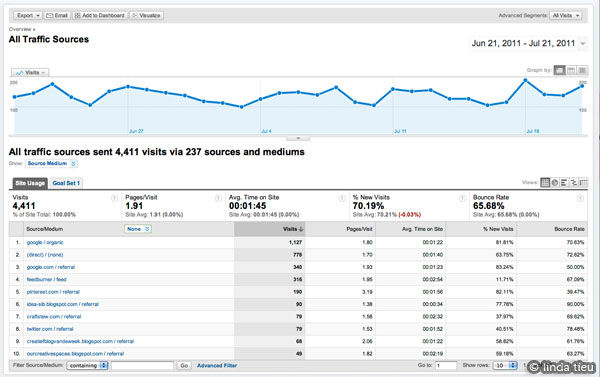
In the end, I do think it’s important to measure your success through analytics or some type of tracking. You can then make decisions about how much time you put into social media, what works and what doesn’t work. This really goes for everything you do! Even if you don’t like burying yourself into the numbers, a quick look will tell you what brings traffic to your site. Maybe you want to concentrate on boosting a certain source or changing a strategy and seeing if it makes a difference. I like to take a look at what pieces of information gets retweeted, liked and shared…to get a good idea of what people find useful. Do you know what sources give you the most traffic? Do you know which links people click on to go to your shop and so forth? Analytics might seem like a huge headache, another thing to learn, but it’s so important! You might be putting a lot of energy into something that simply doesn’t yield results. Or you might be neglecting a goldmine…that could boost you to the next level if you simply give it a bit more time. Yes, you must measure your success (and failures), so you can go back to your ultimate goal, adjust your strategy and keep on interacting and building your business up.
I hope you understand the value in social interactions and the broad reach you are offered through social media. Don’t miss out on a great opportunity, but remember to take action with purpose. Please let me know your thoughts and if you have any tips in the comments below. Thanks!
by Linda | Sep 1, 2011 | my creative journal
These past weeks, I have been concentrating a lot on email marketing in these creative business 101 posts. I’m sure it’s been a bit heavy for some people, so this week let’s get back to the basics and talk a bit about photography. A stunning photo can win people over…I’m sure it’s happened to you as well. So for sellers of products, it’s extremely important to get the best shot possible to showcase your products online. A bad photo just ruins everything, because it also makes you look a bit unprofessional. If you are a large format artist, you will also be using photography to capture the image of something not easily transferred into 2D perhaps…so it is even more important to take care in how you present your work. Even for bloggers, it’s super important to incorporate imagery. The visual element helps to capture people’s attention and break up the content of pages.

Even for those of us who offer services or digital products, photography still comes into play. The visual imagery and design elements you use in your business represents you and your brand. How do you want to look in the eyes of your potential customers? A bit shabby and unkept? Or dreamy stunning amazing, oh-wow-crap-look-at-that amazing?!

I think we all know the answer…or at least closer to the stunning side of the spectrum…rather than shabby, dark and blurry. Most of us have digital cameras and the fabulous thing about digital is that you can try a gazillion times until you get it right. I always have trouble with keeping my hand steady and have invested in a tripod even though I get lazy in actually pulling it out and using it!
However, I’ve also taken classes on basic photography and continue to look for photography resources. Here are some that I have found helpful.

I hope these resources will help you out in your creative business ventures. A great photo will only do good for your business. I know that oftentimes, even though I know the principles…I still get shabby photos. Understand that you have to decide for yourself, the level of tolerance you have…the quality you want ultimately. At some point in your journey, you might need to ask for help – to get a professional photographer when you’ve reached that level. It is worth it, when you are ready. In the meantime, I fully support the DIY movement and thank goodness for the digital format. We can now take as many photos as we need and delete as necessary with little investment. So there’s no excuse…you can certain get decent photos at the least! I’m constantly learning by using my camera more and more. So go take pictures, even if you don’t need them for a specific project. It’s just good practice.
If you have any other helpful links or tips and tricks, please feel free to share below in the comments. Thanks!
by Linda | Aug 25, 2011 | my creative journal
It has come to my attention that I’ve been writing about email marketing without having really mentioned the Can-Spam Act. No doubt you’ve probably heard of it before. It’s a law that has set rules and regulations for people sending email commercial messages.
If you look into the text you notice that applies to all commercial messages…oh, yes!
Despite its name, the CAN-SPAM Act doesn’t apply just to bulk email. It covers all commercial messages, which the law defines as “any electronic mail message the primary purpose of which is the commercial advertisement or promotion of a commercial product or service,” including email that promotes content on commercial websites. The law makes no exception for business-to-business email. That means all email – for example, a message to former customers announcing a new product line – must comply with the law.
Now it’s not meant to scare anyone into communicating about their business…even if it might seem big and scary. Much of it is about common sense and courtesy. If you sign up with an email service provider, they usually have certain restrictions in place to ensure you are following by the law…such as disclosing your location and providing opt-out options. Take a little read and make yourself familiar with the rules. I think it’s all very reasonable and easy to understand.
It’s funny because the people who don’t comply are the spammers we are trying to get rid of…but how do you report them, right? Please add your comments below. I think it’s important for everyone to understand the law…if they are going to use email as a form of marketing their business. Ciao ciao!
by Linda | Aug 18, 2011 | my creative journal
I have to admit that I usually fall into the category of not emailing my list enough. I am plagued by feelings of not having something new to feature and as I’m focusing my efforts behind the scenes on art licensing collections…it’s really something I’m not supposed to share or show off. However, there are other little things going on, here and there and it makes me wonder about email marketing frequency and communicating more with my audience.

I think of my fans and supporters as friends and not communicating with them for a long time seems like a bad thing. I want interaction and I have to keep reminding myself…they signed up, so they want interaction too. However, the number one reason that people unsubscribe from emails is the complaint of too many emails. Did they mean too many from that one person or too many in general? When businesses have a strong following though, supporters actually think it’s okay to receive more messages. Hmm…seems like a toss up!
Would it be better to email regularly and frequently with little bits of information or try to consolidate into a monthly newsletter? Or just fire something off when it applies? On one hand, I think your supporters will be flexible…after all…they like you already! As long as you are sending pertinent information, they will accept it with open arms. But are you losing out by not reminding your fans a few more times about your products and services?
Many of the up and coming indie businesses and influencers today actually email weekly. I’ve also received multiple emails about new product launches. Even when I’m not interested, I just delete, I don’t unsubscribe. Because I still want to stay updated, even though that particular message doesn’t apply. Even when I’m annoyed at getting an email that is simply a repeated blog post – completely redundant since I follow their RSS feed – I don’t unsubscribe because I value the contact and information they will be sending over in the future. Talk about tolerance, eh?

It’s definitely difficult to decide on what makes sense. Suffice to say that you won’t be satisfying everyone – as with everything in life. In fact, you might be whittling your list down as you start implementing certain strategies, because only your true fans and supporters will stick around. In the marketing world it is also stressed that you need to repeat yourself at times. We all need to be reminded several times, before acting. How many times have you heard the famous line…”…oh I totally missed that…”
So back to my dilemma…I think a bit of testing is required. Increasing your email frequency should drive up interaction and hopefully sales, if that is your call to action. At some point you will reach a limit though, when lots of people will start unsubscribing. Basically, the increase will be offset by the unsubscribes – even though unsubscribes are normal for everyone. A general rule says at least once a month, but no more than once a week. Using that as a guideline, I’ve decided that a bit of experimentation is needed to find the right balance. What works for you, your schedule and your audience. Here are some ideas I plan to try out:
- increasing the frequency during product launches or holiday/shopping seasons
- sending occasional specific specials/offers
- sending information – benefits to the readers that ask nothing in return
- repeat emails that are reminders
- creating a new list or sublist for specific efforts, so your audience can opt-in (like daily painting, weekly tips, monthly sales, etc)
Ultimately, I think if you are providing content that your audience wants…it will work out! If suddenly there’s filler content or writing seems forced…then you’ve got a problem. What do you think? Have some tips to contribute? Please comment below and thanks for joining me on this creative business journey!
by Linda | Aug 11, 2011 | my creative journal
When reading about email marketing, you often come across tips and tricks for creating catchy subject lines. Although I understand the importance of attracting readers…I also feel a bit odd using these so called “tricks.” Seems a bit too car saleman-like…and goes back to the issue of how creatives doing their own marketing feel a bit too shy. I’ve found that at times, I must remove myself from my normal role and think like a marketer would think – it’s their job to get folks to open the emails. We are all bombarded by messages daily and although we usually read those sent by people we love and businesses we have opted in for…there are still times when I just delete because I can’t take it all in.

So take a look at the email newsletters that you like to read and try to identify why. Besides wanting to get the information, is there something about the format? Is there something about the text size or organization? Do the subject lines capture you? I think there is a nice medium to creating catching subject lines and being authentic at the same time. The whole point of subject lines is to tell the reader a bit about what they are going to get inside. So I think it’s important to be truthful. However, you can also use some copywriting tips to make it sound nicer, to pique curiosity and grab people’s attention to take the action – click and read!
If you’ve already been doing some newsletters, definitely check your statistics to see what has worked in the past – or not worked. This is valuable information. And although the content and time of year have a lot to do with open rates, I think you can also get a lot of information by looking at past subject lines you have used. If you want to do some testing, certain service providers also let you split campaigns and try different subjects lines. That would give you even more information abotu your readers based on the same email blast.
I use MailChimp for my email newsletters and they even offer a research subject lines tool, to help you craft a better subject line. Although there is no sure-fire formula to creating a successful subject line, there are some rules to guard against looking like spam…or just being plain rude. I would definitely avoid:
- ALL CAPS
- !!!!!!????!?! Lots of exclamation points and punctuation
- spammy words like amazing, free, sexual terms or bad language
- too long of a subject line just looks a bit crazy and unnecessary and beside the point of summing up your email content
Instead, try to sum up your email content or pick the one thing you want to really highlight. Making some kind of offer, offering a benefit or pertinent information or use your authentic clever voice (you know your fans). Sometimes you can make it a question, so people want to know the answer within. It’s also okay to just write [Company Name] Newsletter. I know it seems boring, but if you have a relationship with your customers and send out emails regularly, it just makes sense.
My hope is to find a happy medium between overworked “businessy” marketing phrases and plain boring flat ones. Since everyone has a different audience, it also has a lot to do with what relationship you have with them. What reflects you authentically, communicates the point and gets attention? What subject lines do you like to use? Let me know what you think or if you have any tips in the comments below. Thanks for following along with this creative business 101 series…as I explore topics on my mind, through my own journey in starting a business.
by Linda | Aug 4, 2011 | my creative journal
Do you want to share your passions, products and services with potential customers out there? I’ve come across many creatives who do not setup a newsletter or mailing list, because they feel it’s too early. They worry about not having content to send out…or that only a few people will sign up. What?! It is never too early to start and having a few dedicated fans is the beginning of something beautiful!

Email marketing is so powerful, because it is permission based. It gives you direct access to your fans and supporters and gives them an easy way to just reply and make contact with you in return. Your email listees are asking you to keep them updated…that’s why it’s called permission marketing. Realize what a huge opportunity it is for any business, but especially creatives and indie entrepreneurs. In fact, email marketing is considered one of the most important tools to drive sales. You know how often people check email right? 🙂
Sign-Up For An Email Marketing Service
There are many companies out there that do the job of collecting contact info and storing it into lists, keeping everything organized in a database. The service will ensure you abide by laws, have the unsubscribe links as necessary…all the boring stuff. I do recommend doing a bit of research to ensure you choose a service that makes the most sense for your business…because sometimes it can be a pain to transfer all your contacts into a new provider. Just take a look at the options and choose – many companies offer free service up to a certain number of subscribers and messages before pricing kicks in for high volume users. I personally use MailChimp and love it…but there’s also AWeber and Constant Contact to name just a few others. There’s no excuse not to set something up when your email list is so important and there are so many free options out there.
Tell Everyone About It
Once you have a list setup, not only do you have to put a sign-up box on your website and/or blog, but also ask people to sign up! There are so many opportunities to do so, in social media, online profiles, business cards, advertisements and during day to day interactions with customers. For example, I always send my Etsy buyers a post-sale message that provides them with direct links to Etsy feedback and my newsletter sign-up. It’s a natural progression and you need to make it easier for people to follow you and keep updated. They’ve already bought something from you, so chances are…they love your already! Don’t forget to include in email communications or mentioning it every so often. You do have to ask people to sign-up, because some people don’t pay attention to sidebars. There are interested people out there, they just might happen to be busy the first time you told them about it…so make it an option every so often.
Set Up Your First Message
It’s important to set up a template for your email communications, so that your messages look professional. Some businesses go for the minimal all-text messages, whereas visual artists usually opt for something more designed to show off their work as part of the email. Thankfully, there are many ready-to-go templates that can be selected once you sign up for a service. These days, it’s pretty darn easy to create newsletters with the tools available online.
Test, Manage and Plan
Remember to always send test messages, so you can check out how it looks and check all the links before sending it out. A no-brainer, but mistakes happen all the time and it can be quite annoying to find a broken link or typos here and there. Once you get the hang of it, sending our emails will be a snap and you can manage your statistics as well as plan out a schedule that works with your business within the service provider you have chosen. In my opinion, you don’t need to send messages all the time, but I would say at least every quarter at the least. You can to keep things fresh and alive in the mind of customers…but you must have something worth it to send at the same time. That’s why I don’t like having a forced schedule – although it really depends on your business. Here are some ideas and it’s probably not that difficult to come up with pertinent news to share once you get into it:
- New work! Your fans will definitely want to know about new products and services being offered.
- Offer a discount, sale or limited time offer…maybe for the holidays or a certain celebration.
- In the press – have you been published or interviewed somewhere?
- Show openings, marketplaces and such events to announce?
- Tutorial, tips, fabulous links to share to your audience?
- Class schedules, traveling/show plans?
- Offering your products in other shops? Licensed artwork? In a shop?
- Announcing something newsworthy?
Remember the Ultimate Goal
In the end, never forget that you are communicating with your fans. You should be providing them with something useful – something they would like to see in their inboxes. So don’t forget your audience and the ultimate goal of your email list. It’s a service you are providing to your fans, because they want to stay updated on you and your work. You never want to be forced to just go through the motions though… we are all busy people and no one wants to receive a robot message.
So are you ready? I hope you are inspired to go set up your email list right now. And if you already have one, I hope there’s some good information here for your email marketing effort in general. In the coming weeks, I’ll be delving into specific topics about getting the most out of your email marketing. Please let me know what you think and if you have any other tips to share below in the comments – ciao ciao!
by Linda | Jul 28, 2011 | my creative journal
Do you have business cards ready to hand out to interested parties? Do you have other printed promotional materials to help spread the word about your work, especially if you are a visual artist or have an opportunity to really show off your work through photography? Although it may seem old fashioned, traditional printed material is still amazingly effective as a way of marketing your brand and products.

Business Cards
Although the digital age may seem to have pushed print to the waysides in many arenas, the business card is still alive and thriving. In fact, printing business have reported a surge and demand for printed business cards. Huh, imagine that! I get a lot of my printed materials from Vistaprint and they happen to print business cards more than other other one of their products. Although there are many ways to exchange contact information, especially for online businesses…the traditional business card is much more intimate and immediate. Dating from the Victorian times, “calling cards” were the thing to leave for any respectable gentlewoman/man – and I do have a thing for the Victorian days. Did you know it’s also become “a thing” to order dating cards? Yes, your contact information on a printed card to hand out at bars and social events for singles. 🙂
The point is that the business card is here to stay. They are cheap to print and best in small quanities, so you can change the look and update as often as you like. In fact, it keeps things fresh. It’s like leaving a little part of your brand in prospective customers’ hands. I know there are folks who go all digital…but I think you are missing out. In fact, with the overload of digital these days…print has become the all too missed element in real-life interactions. Let’s just say if you are already super famous…then yeah, you probably don’t need or want to be passing out business cards. But I don’t think that applies to most of us creatives…because we want and need to get ourselves out there and known.

Promotional Printed Materials
The same idea applies for other types of promotional printed materials. Notecards, postcards, magnets, calendars…products galore! It might seem real estate agent cheesy, but you seriously stuck that magnet or calendar on your fridge, right? Didn’t you keep that pad of paper to use it for note writing? With the flood of digital and online marketing these days, again we have print looking a bit special. Snail mail coming back strong and honestly…bring back a sense of real human interaction from business to customer. I love getting postcards and notecards from my favorite illustrators and Etsy shops…it reminds me about their work and gets me to go to their shop for sure.
Also, I find printed materials a great way to spread the love and art…again…email blasting an image to your list is different than actually printing postcards and sending it out. You know the difference and I think you’ve felt it as a consumer yourself. I know that there are hardcore digital folks who say they don’t need the old ways of doing things. I on the other end of the spectrum because I love printed materials myself, think that it’s cheap enough these days to actually be more worth the effort and money spent.
What do you think? Do you have a business card and printed materials to help with marketing? Let me know in the comments below!
by Linda | Jul 25, 2011 | my creative journal
This is the final week of reading The Artist’s Way (here’s a link to the copy I bought on Amazon), chapter 12. I can’t believe these weeks have flown by and as I’m scurrying about preparing for our big vacation in August, I’m also finding the time to reflect upon the reading and exercises I’ve completed.

No doubt, I could have put more time into this journey, but I feel like it’s not necessarily a one time thing. The creative life goes in cycles and we all battle with certain challenging topics over and over again. Hopefully, we get better at dealing with them each time and this book has certainly opened up a new perspective for me.

Every once in a while, I have blogged about wanting to loosen up (not necessarily successful at it though). I seem to have this crazy illusion that I can control what is going on… and when it doesn’t work out, it’s like my world is spiraling out of control.
Even though I understand that it is not necessary to control – or truly that it is impossible to control everything. But I still feel the urge and find myself almost automatically lulled into that type of action. I used to be a project manager. I’m a hardcore virgo – the practical girl. For our vacation, I have printed out all the addresses, directions, phone number lists, descriptions, coupons, confirmations and notes… because we might need it on paper.
The mega vacation “brain” book filled with my typed up notes, possible itineraries by day and hours of operation with phone numbers. Yeah, I realize it all sounds a bit too planned to be a true vacation, but I like to know there are options. At least I don’t have things listed by the hour! I just like having a plan. Perhaps I have learned to let go a little bit, just using all that preparation as backup when necessary.

But thinking about my habits has helped me to realize how uptight I can really be… even though it’s all an illusion. Nothing really works out as planned, but I still can’t seem to truly let go. Perhaps not a coincidence that my word of the year is focus. I’ve been trying to tighten up even more, but failing miserably. I long to be able to let go, get loose, give myself freedom… but just can’t actually do it. Is it possible to let go in an orderly fashion?
Maybe I need extreme chaos instead. Pure, total craziness to shake me out of it all – at least one time – so that I “get” it. Because it’s something that I find terribly uncomfortable. No one wants to let go and feel at the mercy…of…whatever.
And I’ve always wanted to feel like we have control of our lives, that we can make a difference with our efforts and merits. I don’t like the idea of just believing in something bigger and it’ll magically happen. I believe in hard work. I guess it’s not one way or the other… it’s a balance of both, right? You’ve got to do the work, but also have faith. It’s not the first time someone has tried to teach me that.

In the epilogue, I think Cameron’s words are so wise… and remind me that it’s a constant process, this artist journey.
Ultimately, creative living – and it’s okay to have bumps along the way – is a bumpy road, not smooth or straight.
I really like thinking of The Artist’s Way as a spiraling journey up a mountain.
Cameron writes, “As we pursue climbing it, we circle back on the same views, over and over, at slightly different altitudes…” A beautiful analogy!
Related: